The Federal Circuit Expands Disclaimer of Patent Scope During Prosecution

The Federal Circuit Court of Appeals’ recent decision in Focus Products Group International, LLC v. Kartri Sales Co., Inc., No. 2023-1446 (Fed. Cir. Sept. 30, 2025) reversed summary judgment of infringement on two patents and vacated on a third. The Court held the district court erred in both claim construction and application of its infringement analysis by failing to properly find the patent file history disavowed subject matter relied upon to find infringement. The disavowal was critical because the claim language broadly covered the product’s configuration found to be infringing by the district court.
Shower Curtain Ring Image

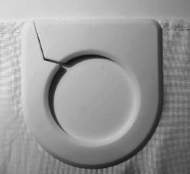
A patent’s claim scope can be narrowed only if the file history contains a “clean and unmistakable” disavowal that overcomes the heavy presumption that claim terms carry their full and ordinary meaning.  In practice, that standard has been difficult to meet even when applicant’s arguments overcame prior art and examiner rejections. The accused device in Focus Products was a shower curtain ring with a flat upper edge (shown here). The Federal Circuit relied on several statements by the examiner that the application’s claims covered different species—one for a ring with projections and another for a ring with a “flat upper edge.” The patentee elected to withdraw claims covering a ring with a flat upper edge without objecting to the examiner’s definition. And in the Notice of Allowance, the examiner again stated that a “flat upper edge” fell outside the scope of the applicant’s election and invited the applicant to challenge that designation.  

The case law on claim disavowal typically requires the applicant to disclaim subject matter that would otherwise fall within the claim and often admonishes cases finding disclaimer based on examiner statements accompanied only by the applicant’s silence. In Focus Products, the Court considered that the applicant cooperated with the examiner’s exclusion of rings with a flat upper edge and therefore made it clear that it accepted the exclusion.

Having consented to the examiner’s claim narrowing, the patentee could not later in litigation reclaim the coverage of a ring with the flat upper edge even though reading the claims in isolation under their ordinary meaning would cover such a configuration.

The significance of the Federal Circuit’s decision is two-fold. First, it confirms that a patent applicant’s disclaimer during prosecution can occur without the applicant’s explicit and absolute disavowal of claim scope, and can be based on the applicant’s failure to challenge the examiner’s findings and taking actions consistent with those findings.

Second, the holding signifies the Federal Circuit’s easing of the standard to find disclaimer, which in practice has typically been a difficult hurdle even when the file history included arguments distinguishing the prior art to gain allowance, which district courts’ often found not clear and unmistakable to therefore not warranting disclaimer of claim scope.

This article is available in the Jenner & Block Japan Newsletter. / この記事はJenner & Blockニュースレターに掲載されています。

© 2026 Jenner & Block LLP. Attorney Advertising. Jenner & Block LLP is an Illinois Limited Liability Partnership including professional corporations. This publication, presentation, or event is not intended to provide legal advice but to provide information on legal matters and/or firm news of interest to our clients and colleagues. Readers or attendees should seek specific legal advice before taking any action with respect to matters mentioned in this publication or at this event. The attorney responsible for this communication is Brent E. Kidwell, Jenner & Block LLP, 353 N. Clark Street, Chicago, IL 60654-3456. Prior results do not guarantee a similar outcome. Jenner & Block London LLP, an affiliate of Jenner & Block LLP, is a limited liability partnership established under the laws of the State of Delaware, USA and is authorised and regulated by the Solicitors Regulation Authority with SRA number 615729. Information regarding the data we collect and the rights you have over your data can be found in our Privacy Notice. For further inquiries, please contact dataprotection@jenner.com.

The Federal Circuit Expands Disclaimer of Patent Scope During Prosecution

The Federal Circuit Court of Appeals’ recent decision in Focus Products Group International, LLC v. Kartri Sales Co., Inc., No. 2023-1446 (Fed. Cir. Sept. 30, 2025) reversed summary judgment of infringement on two patents and vacated on a third. The Court held the district court erred in both claim construction and application of its infringement analysis by failing to properly find the patent file history disavowed subject matter relied upon to find infringement. The disavowal was critical because the claim language broadly covered the product’s configuration found to be infringing by the district court.

Shower Curtain Ring Image

A patent’s claim scope can be narrowed only if the file history contains a “clean and unmistakable” disavowal that overcomes the heavy presumption that claim terms carry their full and ordinary meaning.  In practice, that standard has been difficult to meet even when applicant’s arguments overcame prior art and examiner rejections. The accused device in Focus Products was a shower curtain ring with a flat upper edge (shown here). The Federal Circuit relied on several statements by the examiner that the application’s claims covered different species—one for a ring with projections and another for a ring with a “flat upper edge.” The patentee elected to withdraw claims covering a ring with a flat upper edge without objecting to the examiner’s definition. And in the Notice of Allowance, the examiner again stated that a “flat upper edge” fell outside the scope of the applicant’s election and invited the applicant to challenge that designation.  

The case law on claim disavowal typically requires the applicant to disclaim subject matter that would otherwise fall within the claim and often admonishes cases finding disclaimer based on examiner statements accompanied only by the applicant’s silence. In Focus Products, the Court considered that the applicant cooperated with the examiner’s exclusion of rings with a flat upper edge and therefore made it clear that it accepted the exclusion.

Having consented to the examiner’s claim narrowing, the patentee could not later in litigation reclaim the coverage of a ring with the flat upper edge even though reading the claims in isolation under their ordinary meaning would cover such a configuration.

The significance of the Federal Circuit’s decision is two-fold. First, it confirms that a patent applicant’s disclaimer during prosecution can occur without the applicant’s explicit and absolute disavowal of claim scope, and can be based on the applicant’s failure to challenge the examiner’s findings and taking actions consistent with those findings.

Second, the holding signifies the Federal Circuit’s easing of the standard to find disclaimer, which in practice has typically been a difficult hurdle even when the file history included arguments distinguishing the prior art to gain allowance, which district courts’ often found not clear and unmistakable to therefore not warranting disclaimer of claim scope.

This article is available in the Jenner & Block Japan Newsletter. / この記事はJenner & Blockニュースレターに掲載されています。

© 2026 Jenner & Block LLP. Attorney Advertising. Jenner & Block LLP is an Illinois Limited Liability Partnership including professional corporations. This publication, presentation, or event is not intended to provide legal advice but to provide information on legal matters and/or firm news of interest to our clients and colleagues. Readers or attendees should seek specific legal advice before taking any action with respect to matters mentioned in this publication or at this event. The attorney responsible for this communication is Brent E. Kidwell, Jenner & Block LLP, 353 N. Clark Street, Chicago, IL 60654-3456. Prior results do not guarantee a similar outcome. Jenner & Block London LLP, an affiliate of Jenner & Block LLP, is a limited liability partnership established under the laws of the State of Delaware, USA and is authorised and regulated by the Solicitors Regulation Authority with SRA number 615729. Information regarding the data we collect and the rights you have over your data can be found in our Privacy Notice. For further inquiries, please contact dataprotection@jenner.com.

News and Insights

Publications

In Law360, Partner Samuel Feder Analyzes the Supreme Court's Ruling in FCC v. AT&T

Partner Sam Feder authored an article in Law360 examining the Supreme Court's June 4 decision in Federal Communications Commission v. AT&T Inc., which rejected AT&T's and Verizon's argument that the FCC's forfeiture process violates the Seventh Amendment right to a jury trial.

June 16, 2026

Publications

Partner Emily Loeb Quoted in Semafor on Corporate Risk Ahead of Midterm Elections

Partner Emily Loeb was quoted in Semafor in an article examining how House Democrats plan to leverage a potential midterm election majority to pursue oversight investigations into corporations with ties to the Trump administration.

June 9, 2026