


Client Alert: Congress Increases Merger Filing Fees, Adds Subsidy Reporting Requirements, and Allows State AGs to Block MDL Consolidation
Publications
December 30, 2022
Bottom Line: President Biden signed the Merger Filing Fee Modernization Act of 2022, bringing notable changes to the merger filing process and state antitrust enforcement. The Act does the following: 1) Dramatically increases merger filing fees for the largest transactions while decreasing fees for middle-market deals; 2) Requires disclosure of certain foreign subsidies; and 3) Allows state attorneys general to avoid consolidation of state antitrust cases into multidistrict litigation.
Large transactions will require higher filing fees
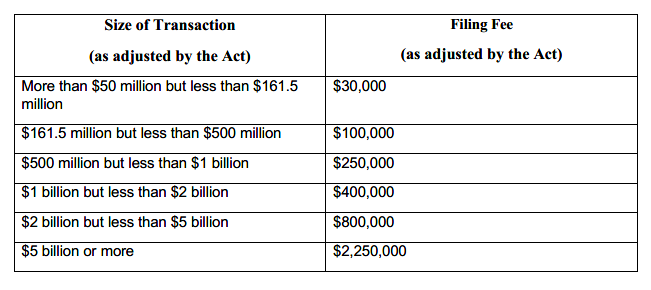
The Act updates premerger notification filing fees under the Hart-Scott-Rodino (“HSR”) Act. Deals valued at less than $1 billion will have fees reduced to a range between $30,000 and $250,000. For transactions valued between $1 billion and $2 billion, the fee will be $400,000; deals between $2 billion and $5 billion will come with an $800,000 fee; and the fee for mergers above $5 billion will be $2.25 million.
The changes do not take immediate effect, so for now the fee structure that has been in place for the last twenty years will remain, with fees capped at $280,000 for transactions valued at $1,009.8 million or greater. Going forward, both the fee thresholds and fees themselves will be adjusted annually based on the Consumer Price Index.
The increase in fees will result in an estimated additional $1.4 billion in funding available to the FTC and DOJ over five years according to the Congressional Budget Office, increased resources that proponents of the higher fees say is necessary to fund agency enforcement priorities. Dealmakers can therefore expect continued aggressive enforcement from better funded agencies.
Companies will need to report subsidies received from certain foreign actors
The Act also requires parties making HSR pre-merger notification filings to disclose subsidies received from foreign entities “of concern,” such as those controlled by governments like China, Russia, and Iran, or entities associated with specifically designated foreign nationals. In addition to the competitive effects such subsidies may have, the reporting requirement is intended to address concerns over the impacts of such subsidies on U.S. national security.
State attorneys general can now prevent MDL consolidation
Finally, the Act allows state attorneys general suing under federal antitrust law to avoid consolidation into multidistrict litigation. This will allow attorneys general to prevent antitrust cases from being consolidated and transferred to a venue outside the home state, which could have the effect of forcing parties to defend functionally identical litigation simultaneously in several locations, an inefficiency the MDL process was designed to avoid, and instead allowing each state’s AG its own “home court advantage.” This provision is not retroactive and will apply only to matters filed after the Act’s enactment.
Main Takeaway
Significantly higher filing fees and increased disclosure requirements add several risks to the deal making process in an already aggressive antitrust landscape. Companies should seek experienced counsel to guide them through these issues.
Large transactions will require higher filing fees
The Act updates premerger notification filing fees under the Hart-Scott-Rodino (“HSR”) Act. Deals valued at less than $1 billion will have fees reduced to a range between $30,000 and $250,000. For transactions valued between $1 billion and $2 billion, the fee will be $400,000; deals between $2 billion and $5 billion will come with an $800,000 fee; and the fee for mergers above $5 billion will be $2.25 million.
The changes do not take immediate effect, so for now the fee structure that has been in place for the last twenty years will remain, with fees capped at $280,000 for transactions valued at $1,009.8 million or greater. Going forward, both the fee thresholds and fees themselves will be adjusted annually based on the Consumer Price Index.
The increase in fees will result in an estimated additional $1.4 billion in funding available to the FTC and DOJ over five years according to the Congressional Budget Office, increased resources that proponents of the higher fees say is necessary to fund agency enforcement priorities. Dealmakers can therefore expect continued aggressive enforcement from better funded agencies.
Companies will need to report subsidies received from certain foreign actors
The Act also requires parties making HSR pre-merger notification filings to disclose subsidies received from foreign entities “of concern,” such as those controlled by governments like China, Russia, and Iran, or entities associated with specifically designated foreign nationals. In addition to the competitive effects such subsidies may have, the reporting requirement is intended to address concerns over the impacts of such subsidies on U.S. national security.
State attorneys general can now prevent MDL consolidation
Finally, the Act allows state attorneys general suing under federal antitrust law to avoid consolidation into multidistrict litigation. This will allow attorneys general to prevent antitrust cases from being consolidated and transferred to a venue outside the home state, which could have the effect of forcing parties to defend functionally identical litigation simultaneously in several locations, an inefficiency the MDL process was designed to avoid, and instead allowing each state’s AG its own “home court advantage.” This provision is not retroactive and will apply only to matters filed after the Act’s enactment.
Main Takeaway
Significantly higher filing fees and increased disclosure requirements add several risks to the deal making process in an already aggressive antitrust landscape. Companies should seek experienced counsel to guide them through these issues.
Related Capabilities
© 2026 Jenner & Block LLP. Attorney Advertising. Jenner & Block LLP is an Illinois Limited Liability Partnership including professional corporations. This publication, presentation, or event is not intended to provide legal advice but to provide information on legal matters and/or firm news of interest to our clients and colleagues. Readers or attendees should seek specific legal advice before taking any action with respect to matters mentioned in this publication or at this event. The attorney responsible for this communication is Brent E. Kidwell, Jenner & Block LLP, 353 N. Clark Street, Chicago, IL 60654-3456. Prior results do not guarantee a similar outcome. Jenner & Block London LLP, an affiliate of Jenner & Block LLP, is a limited liability partnership established under the laws of the State of Delaware, USA and is authorised and regulated by the Solicitors Regulation Authority with SRA number 615729. Information regarding the data we collect and the rights you have over your data can be found in our Privacy Notice. For further inquiries, please contact dataprotection@jenner.com.
Publications
December 30, 2022
Bottom Line: President Biden signed the Merger Filing Fee Modernization Act of 2022, bringing notable changes to the merger filing process and state antitrust enforcement. The Act does the following: 1) Dramatically increases merger filing fees for the largest transactions while decreasing fees for middle-market deals; 2) Requires disclosure of certain foreign subsidies; and 3) Allows state attorneys general to avoid consolidation of state antitrust cases into multidistrict litigation.
Large transactions will require higher filing fees
The Act updates premerger notification filing fees under the Hart-Scott-Rodino (“HSR”) Act. Deals valued at less than $1 billion will have fees reduced to a range between $30,000 and $250,000. For transactions valued between $1 billion and $2 billion, the fee will be $400,000; deals between $2 billion and $5 billion will come with an $800,000 fee; and the fee for mergers above $5 billion will be $2.25 million.
The changes do not take immediate effect, so for now the fee structure that has been in place for the last twenty years will remain, with fees capped at $280,000 for transactions valued at $1,009.8 million or greater. Going forward, both the fee thresholds and fees themselves will be adjusted annually based on the Consumer Price Index.
The increase in fees will result in an estimated additional $1.4 billion in funding available to the FTC and DOJ over five years according to the Congressional Budget Office, increased resources that proponents of the higher fees say is necessary to fund agency enforcement priorities. Dealmakers can therefore expect continued aggressive enforcement from better funded agencies.
Companies will need to report subsidies received from certain foreign actors
The Act also requires parties making HSR pre-merger notification filings to disclose subsidies received from foreign entities “of concern,” such as those controlled by governments like China, Russia, and Iran, or entities associated with specifically designated foreign nationals. In addition to the competitive effects such subsidies may have, the reporting requirement is intended to address concerns over the impacts of such subsidies on U.S. national security.
State attorneys general can now prevent MDL consolidation
Finally, the Act allows state attorneys general suing under federal antitrust law to avoid consolidation into multidistrict litigation. This will allow attorneys general to prevent antitrust cases from being consolidated and transferred to a venue outside the home state, which could have the effect of forcing parties to defend functionally identical litigation simultaneously in several locations, an inefficiency the MDL process was designed to avoid, and instead allowing each state’s AG its own “home court advantage.” This provision is not retroactive and will apply only to matters filed after the Act’s enactment.
Main Takeaway
Significantly higher filing fees and increased disclosure requirements add several risks to the deal making process in an already aggressive antitrust landscape. Companies should seek experienced counsel to guide them through these issues.
Large transactions will require higher filing fees
The Act updates premerger notification filing fees under the Hart-Scott-Rodino (“HSR”) Act. Deals valued at less than $1 billion will have fees reduced to a range between $30,000 and $250,000. For transactions valued between $1 billion and $2 billion, the fee will be $400,000; deals between $2 billion and $5 billion will come with an $800,000 fee; and the fee for mergers above $5 billion will be $2.25 million.
The changes do not take immediate effect, so for now the fee structure that has been in place for the last twenty years will remain, with fees capped at $280,000 for transactions valued at $1,009.8 million or greater. Going forward, both the fee thresholds and fees themselves will be adjusted annually based on the Consumer Price Index.
The increase in fees will result in an estimated additional $1.4 billion in funding available to the FTC and DOJ over five years according to the Congressional Budget Office, increased resources that proponents of the higher fees say is necessary to fund agency enforcement priorities. Dealmakers can therefore expect continued aggressive enforcement from better funded agencies.
Companies will need to report subsidies received from certain foreign actors
The Act also requires parties making HSR pre-merger notification filings to disclose subsidies received from foreign entities “of concern,” such as those controlled by governments like China, Russia, and Iran, or entities associated with specifically designated foreign nationals. In addition to the competitive effects such subsidies may have, the reporting requirement is intended to address concerns over the impacts of such subsidies on U.S. national security.
State attorneys general can now prevent MDL consolidation
Finally, the Act allows state attorneys general suing under federal antitrust law to avoid consolidation into multidistrict litigation. This will allow attorneys general to prevent antitrust cases from being consolidated and transferred to a venue outside the home state, which could have the effect of forcing parties to defend functionally identical litigation simultaneously in several locations, an inefficiency the MDL process was designed to avoid, and instead allowing each state’s AG its own “home court advantage.” This provision is not retroactive and will apply only to matters filed after the Act’s enactment.
Main Takeaway
Significantly higher filing fees and increased disclosure requirements add several risks to the deal making process in an already aggressive antitrust landscape. Companies should seek experienced counsel to guide them through these issues.
Related Capabilities
© 2026 Jenner & Block LLP. Attorney Advertising. Jenner & Block LLP is an Illinois Limited Liability Partnership including professional corporations. This publication, presentation, or event is not intended to provide legal advice but to provide information on legal matters and/or firm news of interest to our clients and colleagues. Readers or attendees should seek specific legal advice before taking any action with respect to matters mentioned in this publication or at this event. The attorney responsible for this communication is Brent E. Kidwell, Jenner & Block LLP, 353 N. Clark Street, Chicago, IL 60654-3456. Prior results do not guarantee a similar outcome. Jenner & Block London LLP, an affiliate of Jenner & Block LLP, is a limited liability partnership established under the laws of the State of Delaware, USA and is authorised and regulated by the Solicitors Regulation Authority with SRA number 615729. Information regarding the data we collect and the rights you have over your data can be found in our Privacy Notice. For further inquiries, please contact dataprotection@jenner.com.
News and Insights
Event
Amanda Shafer Berman to Speak on Energy and Administrative Law at WEN-DC Webinar
As the Supreme Court's new Term begins, Jenner & Block Partner Amanda Shafer Berman will join a Women's Energy Network of Washington, DC (WEN-DC) webinar on how the Court's decisions are shaping the energy sector.
October 14, 2026
Publications
Partner Amanda Shafer Berman Quoted in Bloomberg Law on Senate Permitting Overhaul Bill
Partner Amanda Shafer Berman was quoted in an October 5 Bloomberg Law article, "Permitting Deal Gives Projects Defense Against Litigation Delays," on the Senate's new permitting overhaul package and its expected impact on litigation over federal permitting reversals.
October 2026
Event
Partner John Storino to Speak at Sandpiper Partners' “AI and Outside Counsel Guidelines Roundtable”
On October 8, Partner John Storino will serve as a panelist at the “AI and Outside Counsel Guidelines Roundtable,” hosted by Sandpiper Partners in Chicago.
October 8, 2026
Event
Partner Meghan Greenfield to Speak on Supreme Court Climate Case at Edison Electric Institute's Fall Legal Conference
On Wednesday, October 7, Partner Meghan Greenfield will speak on a panel titled "Boulder County v. Suncor Energy: What the Supreme Court's Climate Case Means for the Energy Industry" at the Edison Electric Institute's Fall Legal Conference in Salt Lake City, Utah.
October 7, 2026
Publications
The Form Rules Everything: A Seventh Circuit Ruling on ERISA's Substantial Compliance Doctrine
Partner Joseph Torres and Special Counsel Jennifer Beach authored an article for Employee Relations Law Journal examining the Seventh Circuit's decision in Packaging Corp. of America Thrift Plan for Hourly Employees v. Langdon, a ruling that addresses both the standard of review in ERISA interpleader actions and the continued viability of the substantial compliance doctrine for changing plan beneficiaries.
October 5, 2026