


Client Alert: Suspension and Debarment: FY 2023 By The Numbers, Law360
With fiscal year 2023 behind us, it is once again time to analyze what the federal government's suspension and debarment apparatus did over the past 12 months.
Spoiler alert: After a not-insubstantial uptick in fiscal year 2022, overall suspension and debarment numbers fell dramatically in 2023.
This dip occurs at a time of challenge for the government suspension and debarment community. For example, in a recently published interim rule amending the Federal Acquistion Regulation, the government is routinizing a process to implement "supply chain risk information sharing and exclusion or removal orders" consistent with the Federal Acquisition Supply Chain Security Act of 2018, without using the suspension and debarment apparatus.[1]
And the statutorily required annual report of the Interagency Suspension and Debarment Committee, or ISDC, which could provide some context for the drop in numbers, is now running three years behind.[2]
This annual series represents this author's efforts to fill the information void by using publicly available data. As has been the case every year we have run this article, our analysis focuses on a subset of federal agencies with suspension and debarment authority. We have focused on the more active agencies that have a nexus to government contracting.
Many other agencies have statutory or discretionary exclusion programs, but they tend to focus on issues or industries that are less relevant to the government contracting community. As such, they fall outside the scope of this article.
This analysis is taken directly from the authoritative source of suspension and debarment data — the System for Award Management, or SAM.gov, database. This information is available in real time for those who wish to review it. Our analysis aggregates fiscal year 2023 data and compares it with data from prior years.
The real-time availability of SAM data is vitally important to contractors because it enables a better understanding of the enforcement climate, and shows trends that permit adjustments in internal controls and compliance efforts in near-real time.
The numbers show that overall suspensions and debarments fell to half of what they were during fiscal year 2022. The numbers were down across the board, in every category.
SAM Data Versus ISDC Data
It is important to note that the data reviewed in this article is substantially different from the information published by the ISDC in its report to Congress, required by statute to be annual but is far less frequent.
The ISDC report lists separately the numbers of suspensions, debarments and proposed debarments by agency. As such, the ISDC report measures the total number of times an agency issues any kind of action during a fiscal year.
For example, if an agency suspended, proposed for debarment and debarred a single contractor in a year, then the ISDC report would count that as three actions. But that tally is not helpful as the public seeks to understand the number of companies or individuals that were subjected to exclusions.
Stated differently, the ISDC report does not help the public understand how common exclusions are. The ISDC report only shares how many actions occurred and is silent on how many respondents were involved.
This is why we write our annual by-the-numbers series. We do this work to help contractors assess risks and adjust conduct.
Fiscal Year 2023 at a Glance
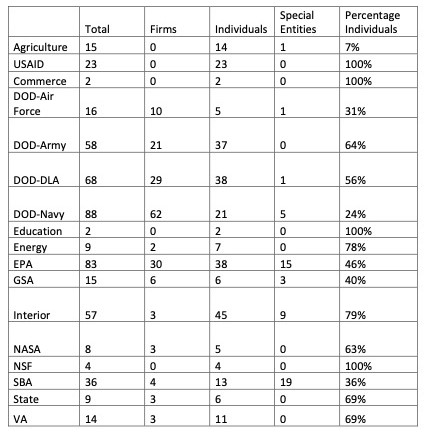
In last year's article, we noted that multiple agencies listed multiple common names, and that those common names may have skewed the count upward to make the year appear more active than it actually was. This year, we approached the count differently and removed the common entries from the table.
A primary purpose of this article is to isolate the number of businesses and individuals excluded by each of these agencies in the fiscal year in order to give the most accurate view possible of agency activity. Common names skewed the analysis. This year, due to enhanced Excel skills by the author that permit better grouping of common names, we were able to remove the common names from the table.
In the interest of full transparency, here are the numbers we removed from the table:
-
- The S. Department of Agriculture had five common names.
- The S. Agency for International Development had eight common names.
- The S. Department of the Army had three individuals with common names, as well as one firm and one special entity with common names.
- The Defense Logistics Agency had three commonly named companies, and one individual with common names.
- The S. Department of the Interior had four common special-entity names, and four common individual names.
- NASA had three common individual names.
- The S. Department of Veterans Affairs had two firms, each with three common names.
Also, we note that the U.S. Department of the Navy excluded 62 firms this past fiscal year. Of those, 48 firms — or 77% — were Glenn Marine Group-affiliated companies caught up in the so-called Fat Leonard bribery scandal. Because those are distinct business entities, we did not remove those commonly owned companies from the table.
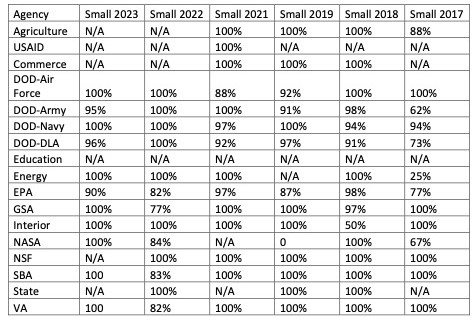
Fiscal year 2023 saw a continued tendency to exclude small, U.S.-based firms — companies with indicia of participating in government contracting — as compared to large U.S.-based firms.
While last year we noted that the move away from Data Universal Numbering System numbers for the purpose of identifying contractors could skew the data in the SAM database, it appears that the move to unique entity identifiers has not negatively affected data quality.
A nonscientific sample review of data suggests that, at least so far, firms continue to have indicia of being active in government contracting and special entities seem less tied to the industry.
As always, analyzing business size is more art than science. Open-source business intelligence services like Buzzfile are helpful for looking up company revenue and employee numbers. But as is the case every year, this table still reflects the use of this author's judgment on size.
And as a reminder, we left out business-size figures for pandemic-affected 2020 because of concerns that the move to remote work and other pandemic distractions might have skewed the data.
Comparison of Fiscal Year 2016 Through Fiscal Year 2023 Numbers
Before we list the table of total exclusions by year, we note a correction in the fiscal year 2022 data that we published last year. Due to a technical error, the Department of the Navy's numbers were not separately broken out and therefore were not included in the comparison table.
So, 2022 numbers now include 96 additional exclusions, made up of 11 firms, 37 individuals and 48 special entities that were not present in last year's data.
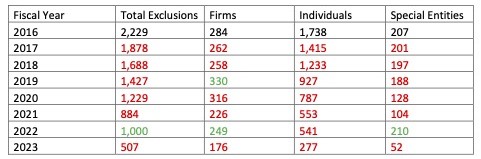
Fiscal year 2023 exclusions dropped by half as compared with fiscal year 2022. Exclusions of firms dropped 30%. Just over half as many individuals were excluded, and just about a quarter as many special entities were excluded in 2023 as in fiscal year 2022.
Illustrated graphically, here are the trend lines:
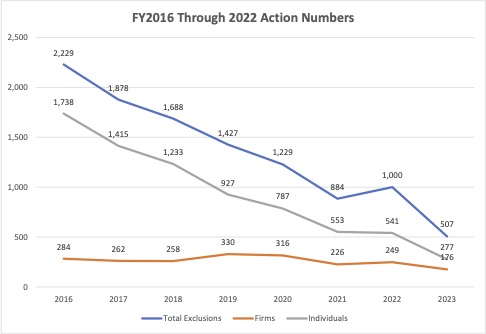
This author is at a loss.
Fiscal year 2022 data showed an uptick in suspension and debarment activity for the first time in a long while. And now that the Department of the Navy numbers are included in the fiscal year 2022 data, because we corrected our technical issue, we see the increase was even larger than we previously understood.
Further, the belatedly issued fiscal year 2020 ISDC report showed innovation when it was published in 2022.[3] Those of us who were expecting this to result in a more active 2023 fiscal year were wrong.
This series is always at the mercy of the SAM.gov system and whether the software is working properly.
For example, we had to search a second time to get numbers for the U.S. Department of State and U.S. Department of Commerce because SAM.gov returned no data for them during our first search.
But when we reran the SAM.gov data, the numbers did not change for the other agencies. While we can never fully rule out database error, it appears that 2023 was the slowest year in recent history.
We remain at a loss to explain why.
There is no publicly available information about the number of government employees engaged in suspension and debarment activities, so we do not know if a reduction in staff caused the decrease in actions.
There is no way for the public to know whether there were changes in government referral processes or investigative resources that decreased potential actions.
Regardless of statutory requirements, the ISDC does not issue timely reports — which, as we have noted in this series, is not the ISDC's fault as it cannot control when its report is released. So we do not know if any new initiatives caused the decrease in actions.
There have not been recent U.S. Government Accountability Office audits or offices of inspectors general audits, or reviews of the effectiveness of the suspension and debarment system, so the public does not know what issues might be affecting action numbers.
We do know that recent years have witnessed a significant number of new suspending and debarring officials.[4] Perhaps these new officials have additional duties and have less time to focus on exclusions. Or perhaps they have different philosophies and prefer preexclusion engagement such as through show-cause letters or in response to voluntary submissions.
Or it is possible that the government has realized that the contracting community as a whole is highly ethical, compliant, presently responsible, and therefore ill-deserving of suspension or debarment?
After all, the number of exclusions is not the only measure of effectiveness in suspension and debarment. But such a significant year-over-year drop in numbers leaves the broader government contracting community scratching our collective heads trying to figure out what is happening.
This annual series represents this author's efforts to fill the information void by using publicly available data. As has been the case every year we have run this article, our analysis focuses on a subset of federal agencies with suspension and debarment authority. We have focused on the more active agencies that have a nexus to government contracting.
Many other agencies have statutory or discretionary exclusion programs, but they tend to focus on issues or industries that are less relevant to the government contracting community. As such, they fall outside the scope of this article.
This analysis is taken directly from the authoritative source of suspension and debarment data — the System for Award Management, or SAM.gov, database. This information is available in real time for those who wish to review it. Our analysis aggregates fiscal year 2023 data and compares it with data from prior years.
The real-time availability of SAM data is vitally important to contractors because it enables a better understanding of the enforcement climate, and shows trends that permit adjustments in internal controls and compliance efforts in near-real time.
The numbers show that overall suspensions and debarments fell to half of what they were during fiscal year 2022. The numbers were down across the board, in every category.
SAM Data Versus ISDC Data
It is important to note that the data reviewed in this article is substantially different from the information published by the ISDC in its report to Congress, required by statute to be annual but is far less frequent.
The ISDC report lists separately the numbers of suspensions, debarments and proposed debarments by agency. As such, the ISDC report measures the total number of times an agency issues any kind of action during a fiscal year.
For example, if an agency suspended, proposed for debarment and debarred a single contractor in a year, then the ISDC report would count that as three actions. But that tally is not helpful as the public seeks to understand the number of companies or individuals that were subjected to exclusions.
Stated differently, the ISDC report does not help the public understand how common exclusions are. The ISDC report only shares how many actions occurred and is silent on how many respondents were involved.
This is why we write our annual by-the-numbers series. We do this work to help contractors assess risks and adjust conduct.
Fiscal Year 2023 at a Glance
In last year's article, we noted that multiple agencies listed multiple common names, and that those common names may have skewed the count upward to make the year appear more active than it actually was. This year, we approached the count differently and removed the common entries from the table.
A primary purpose of this article is to isolate the number of businesses and individuals excluded by each of these agencies in the fiscal year in order to give the most accurate view possible of agency activity. Common names skewed the analysis. This year, due to enhanced Excel skills by the author that permit better grouping of common names, we were able to remove the common names from the table.
In the interest of full transparency, here are the numbers we removed from the table:
-
- The S. Department of Agriculture had five common names.
- The S. Agency for International Development had eight common names.
- The S. Department of the Army had three individuals with common names, as well as one firm and one special entity with common names.
- The Defense Logistics Agency had three commonly named companies, and one individual with common names.
- The S. Department of the Interior had four common special-entity names, and four common individual names.
- NASA had three common individual names.
- The S. Department of Veterans Affairs had two firms, each with three common names.
Also, we note that the U.S. Department of the Navy excluded 62 firms this past fiscal year. Of those, 48 firms — or 77% — were Glenn Marine Group-affiliated companies caught up in the so-called Fat Leonard bribery scandal. Because those are distinct business entities, we did not remove those commonly owned companies from the table.
Fiscal year 2023 saw a continued tendency to exclude small, U.S.-based firms — companies with indicia of participating in government contracting — as compared to large U.S.-based firms.
While last year we noted that the move away from Data Universal Numbering System numbers for the purpose of identifying contractors could skew the data in the SAM database, it appears that the move to unique entity identifiers has not negatively affected data quality.
A nonscientific sample review of data suggests that, at least so far, firms continue to have indicia of being active in government contracting and special entities seem less tied to the industry.
As always, analyzing business size is more art than science. Open-source business intelligence services like Buzzfile are helpful for looking up company revenue and employee numbers. But as is the case every year, this table still reflects the use of this author's judgment on size.
And as a reminder, we left out business-size figures for pandemic-affected 2020 because of concerns that the move to remote work and other pandemic distractions might have skewed the data.
Comparison of Fiscal Year 2016 Through Fiscal Year 2023 Numbers
Before we list the table of total exclusions by year, we note a correction in the fiscal year 2022 data that we published last year. Due to a technical error, the Department of the Navy's numbers were not separately broken out and therefore were not included in the comparison table.
So, 2022 numbers now include 96 additional exclusions, made up of 11 firms, 37 individuals and 48 special entities that were not present in last year's data.
Fiscal year 2023 exclusions dropped by half as compared with fiscal year 2022. Exclusions of firms dropped 30%. Just over half as many individuals were excluded, and just about a quarter as many special entities were excluded in 2023 as in fiscal year 2022.
Illustrated graphically, here are the trend lines:
This author is at a loss.
Fiscal year 2022 data showed an uptick in suspension and debarment activity for the first time in a long while. And now that the Department of the Navy numbers are included in the fiscal year 2022 data, because we corrected our technical issue, we see the increase was even larger than we previously understood.
Further, the belatedly issued fiscal year 2020 ISDC report showed innovation when it was published in 2022.[3] Those of us who were expecting this to result in a more active 2023 fiscal year were wrong.
This series is always at the mercy of the SAM.gov system and whether the software is working properly.
For example, we had to search a second time to get numbers for the U.S. Department of State and U.S. Department of Commerce because SAM.gov returned no data for them during our first search.
But when we reran the SAM.gov data, the numbers did not change for the other agencies. While we can never fully rule out database error, it appears that 2023 was the slowest year in recent history.
We remain at a loss to explain why.
There is no publicly available information about the number of government employees engaged in suspension and debarment activities, so we do not know if a reduction in staff caused the decrease in actions.
There is no way for the public to know whether there were changes in government referral processes or investigative resources that decreased potential actions.
Regardless of statutory requirements, the ISDC does not issue timely reports — which, as we have noted in this series, is not the ISDC's fault as it cannot control when its report is released. So we do not know if any new initiatives caused the decrease in actions.
There have not been recent U.S. Government Accountability Office audits or offices of inspectors general audits, or reviews of the effectiveness of the suspension and debarment system, so the public does not know what issues might be affecting action numbers.
We do know that recent years have witnessed a significant number of new suspending and debarring officials.[4] Perhaps these new officials have additional duties and have less time to focus on exclusions. Or perhaps they have different philosophies and prefer preexclusion engagement such as through show-cause letters or in response to voluntary submissions.
Or it is possible that the government has realized that the contracting community as a whole is highly ethical, compliant, presently responsible, and therefore ill-deserving of suspension or debarment?
After all, the number of exclusions is not the only measure of effectiveness in suspension and debarment. But such a significant year-over-year drop in numbers leaves the broader government contracting community scratching our collective heads trying to figure out what is happening.
[2] See https://www.acquisition.gov/isdc-reporting (Fiscal Year 2020 is the most recent report available).
[3] https://www.law360.com/articles/1485135/new-suspension-and-debarment-report-shows-innovation.
Footnotes
[2] See https://www.acquisition.gov/isdc-reporting (Fiscal Year 2020 is the most recent report available).
[3] https://www.law360.com/articles/1485135/new-suspension-and-debarment-report-shows-innovation.
Related Lawyers

Related Capabilities
© 2026 Jenner & Block LLP. Attorney Advertising. Jenner & Block LLP is an Illinois Limited Liability Partnership including professional corporations. This publication, presentation, or event is not intended to provide legal advice but to provide information on legal matters and/or firm news of interest to our clients and colleagues. Readers or attendees should seek specific legal advice before taking any action with respect to matters mentioned in this publication or at this event. The attorney responsible for this communication is Brent E. Kidwell, Jenner & Block LLP, 353 N. Clark Street, Chicago, IL 60654-3456. Prior results do not guarantee a similar outcome. Jenner & Block London LLP, an affiliate of Jenner & Block LLP, is a limited liability partnership established under the laws of the State of Delaware, USA and is authorised and regulated by the Solicitors Regulation Authority with SRA number 615729. Information regarding the data we collect and the rights you have over your data can be found in our Privacy Notice. For further inquiries, please contact dataprotection@jenner.com.
With fiscal year 2023 behind us, it is once again time to analyze what the federal government's suspension and debarment apparatus did over the past 12 months.
Spoiler alert: After a not-insubstantial uptick in fiscal year 2022, overall suspension and debarment numbers fell dramatically in 2023.
This dip occurs at a time of challenge for the government suspension and debarment community. For example, in a recently published interim rule amending the Federal Acquistion Regulation, the government is routinizing a process to implement "supply chain risk information sharing and exclusion or removal orders" consistent with the Federal Acquisition Supply Chain Security Act of 2018, without using the suspension and debarment apparatus.[1]
And the statutorily required annual report of the Interagency Suspension and Debarment Committee, or ISDC, which could provide some context for the drop in numbers, is now running three years behind.[2]
This annual series represents this author's efforts to fill the information void by using publicly available data. As has been the case every year we have run this article, our analysis focuses on a subset of federal agencies with suspension and debarment authority. We have focused on the more active agencies that have a nexus to government contracting.
Many other agencies have statutory or discretionary exclusion programs, but they tend to focus on issues or industries that are less relevant to the government contracting community. As such, they fall outside the scope of this article.
This analysis is taken directly from the authoritative source of suspension and debarment data — the System for Award Management, or SAM.gov, database. This information is available in real time for those who wish to review it. Our analysis aggregates fiscal year 2023 data and compares it with data from prior years.
The real-time availability of SAM data is vitally important to contractors because it enables a better understanding of the enforcement climate, and shows trends that permit adjustments in internal controls and compliance efforts in near-real time.
The numbers show that overall suspensions and debarments fell to half of what they were during fiscal year 2022. The numbers were down across the board, in every category.
SAM Data Versus ISDC Data
It is important to note that the data reviewed in this article is substantially different from the information published by the ISDC in its report to Congress, required by statute to be annual but is far less frequent.
The ISDC report lists separately the numbers of suspensions, debarments and proposed debarments by agency. As such, the ISDC report measures the total number of times an agency issues any kind of action during a fiscal year.
For example, if an agency suspended, proposed for debarment and debarred a single contractor in a year, then the ISDC report would count that as three actions. But that tally is not helpful as the public seeks to understand the number of companies or individuals that were subjected to exclusions.
Stated differently, the ISDC report does not help the public understand how common exclusions are. The ISDC report only shares how many actions occurred and is silent on how many respondents were involved.
This is why we write our annual by-the-numbers series. We do this work to help contractors assess risks and adjust conduct.
Fiscal Year 2023 at a Glance
In last year's article, we noted that multiple agencies listed multiple common names, and that those common names may have skewed the count upward to make the year appear more active than it actually was. This year, we approached the count differently and removed the common entries from the table.
A primary purpose of this article is to isolate the number of businesses and individuals excluded by each of these agencies in the fiscal year in order to give the most accurate view possible of agency activity. Common names skewed the analysis. This year, due to enhanced Excel skills by the author that permit better grouping of common names, we were able to remove the common names from the table.
In the interest of full transparency, here are the numbers we removed from the table:
-
- The S. Department of Agriculture had five common names.
- The S. Agency for International Development had eight common names.
- The S. Department of the Army had three individuals with common names, as well as one firm and one special entity with common names.
- The Defense Logistics Agency had three commonly named companies, and one individual with common names.
- The S. Department of the Interior had four common special-entity names, and four common individual names.
- NASA had three common individual names.
- The S. Department of Veterans Affairs had two firms, each with three common names.
Also, we note that the U.S. Department of the Navy excluded 62 firms this past fiscal year. Of those, 48 firms — or 77% — were Glenn Marine Group-affiliated companies caught up in the so-called Fat Leonard bribery scandal. Because those are distinct business entities, we did not remove those commonly owned companies from the table.
Fiscal year 2023 saw a continued tendency to exclude small, U.S.-based firms — companies with indicia of participating in government contracting — as compared to large U.S.-based firms.
While last year we noted that the move away from Data Universal Numbering System numbers for the purpose of identifying contractors could skew the data in the SAM database, it appears that the move to unique entity identifiers has not negatively affected data quality.
A nonscientific sample review of data suggests that, at least so far, firms continue to have indicia of being active in government contracting and special entities seem less tied to the industry.
As always, analyzing business size is more art than science. Open-source business intelligence services like Buzzfile are helpful for looking up company revenue and employee numbers. But as is the case every year, this table still reflects the use of this author's judgment on size.
And as a reminder, we left out business-size figures for pandemic-affected 2020 because of concerns that the move to remote work and other pandemic distractions might have skewed the data.
Comparison of Fiscal Year 2016 Through Fiscal Year 2023 Numbers
Before we list the table of total exclusions by year, we note a correction in the fiscal year 2022 data that we published last year. Due to a technical error, the Department of the Navy's numbers were not separately broken out and therefore were not included in the comparison table.
So, 2022 numbers now include 96 additional exclusions, made up of 11 firms, 37 individuals and 48 special entities that were not present in last year's data.
Fiscal year 2023 exclusions dropped by half as compared with fiscal year 2022. Exclusions of firms dropped 30%. Just over half as many individuals were excluded, and just about a quarter as many special entities were excluded in 2023 as in fiscal year 2022.
Illustrated graphically, here are the trend lines:
This author is at a loss.
Fiscal year 2022 data showed an uptick in suspension and debarment activity for the first time in a long while. And now that the Department of the Navy numbers are included in the fiscal year 2022 data, because we corrected our technical issue, we see the increase was even larger than we previously understood.
Further, the belatedly issued fiscal year 2020 ISDC report showed innovation when it was published in 2022.[3] Those of us who were expecting this to result in a more active 2023 fiscal year were wrong.
This series is always at the mercy of the SAM.gov system and whether the software is working properly.
For example, we had to search a second time to get numbers for the U.S. Department of State and U.S. Department of Commerce because SAM.gov returned no data for them during our first search.
But when we reran the SAM.gov data, the numbers did not change for the other agencies. While we can never fully rule out database error, it appears that 2023 was the slowest year in recent history.
We remain at a loss to explain why.
There is no publicly available information about the number of government employees engaged in suspension and debarment activities, so we do not know if a reduction in staff caused the decrease in actions.
There is no way for the public to know whether there were changes in government referral processes or investigative resources that decreased potential actions.
Regardless of statutory requirements, the ISDC does not issue timely reports — which, as we have noted in this series, is not the ISDC's fault as it cannot control when its report is released. So we do not know if any new initiatives caused the decrease in actions.
There have not been recent U.S. Government Accountability Office audits or offices of inspectors general audits, or reviews of the effectiveness of the suspension and debarment system, so the public does not know what issues might be affecting action numbers.
We do know that recent years have witnessed a significant number of new suspending and debarring officials.[4] Perhaps these new officials have additional duties and have less time to focus on exclusions. Or perhaps they have different philosophies and prefer preexclusion engagement such as through show-cause letters or in response to voluntary submissions.
Or it is possible that the government has realized that the contracting community as a whole is highly ethical, compliant, presently responsible, and therefore ill-deserving of suspension or debarment?
After all, the number of exclusions is not the only measure of effectiveness in suspension and debarment. But such a significant year-over-year drop in numbers leaves the broader government contracting community scratching our collective heads trying to figure out what is happening.
This annual series represents this author's efforts to fill the information void by using publicly available data. As has been the case every year we have run this article, our analysis focuses on a subset of federal agencies with suspension and debarment authority. We have focused on the more active agencies that have a nexus to government contracting.
Many other agencies have statutory or discretionary exclusion programs, but they tend to focus on issues or industries that are less relevant to the government contracting community. As such, they fall outside the scope of this article.
This analysis is taken directly from the authoritative source of suspension and debarment data — the System for Award Management, or SAM.gov, database. This information is available in real time for those who wish to review it. Our analysis aggregates fiscal year 2023 data and compares it with data from prior years.
The real-time availability of SAM data is vitally important to contractors because it enables a better understanding of the enforcement climate, and shows trends that permit adjustments in internal controls and compliance efforts in near-real time.
The numbers show that overall suspensions and debarments fell to half of what they were during fiscal year 2022. The numbers were down across the board, in every category.
SAM Data Versus ISDC Data
It is important to note that the data reviewed in this article is substantially different from the information published by the ISDC in its report to Congress, required by statute to be annual but is far less frequent.
The ISDC report lists separately the numbers of suspensions, debarments and proposed debarments by agency. As such, the ISDC report measures the total number of times an agency issues any kind of action during a fiscal year.
For example, if an agency suspended, proposed for debarment and debarred a single contractor in a year, then the ISDC report would count that as three actions. But that tally is not helpful as the public seeks to understand the number of companies or individuals that were subjected to exclusions.
Stated differently, the ISDC report does not help the public understand how common exclusions are. The ISDC report only shares how many actions occurred and is silent on how many respondents were involved.
This is why we write our annual by-the-numbers series. We do this work to help contractors assess risks and adjust conduct.
Fiscal Year 2023 at a Glance
In last year's article, we noted that multiple agencies listed multiple common names, and that those common names may have skewed the count upward to make the year appear more active than it actually was. This year, we approached the count differently and removed the common entries from the table.
A primary purpose of this article is to isolate the number of businesses and individuals excluded by each of these agencies in the fiscal year in order to give the most accurate view possible of agency activity. Common names skewed the analysis. This year, due to enhanced Excel skills by the author that permit better grouping of common names, we were able to remove the common names from the table.
In the interest of full transparency, here are the numbers we removed from the table:
-
- The S. Department of Agriculture had five common names.
- The S. Agency for International Development had eight common names.
- The S. Department of the Army had three individuals with common names, as well as one firm and one special entity with common names.
- The Defense Logistics Agency had three commonly named companies, and one individual with common names.
- The S. Department of the Interior had four common special-entity names, and four common individual names.
- NASA had three common individual names.
- The S. Department of Veterans Affairs had two firms, each with three common names.
Also, we note that the U.S. Department of the Navy excluded 62 firms this past fiscal year. Of those, 48 firms — or 77% — were Glenn Marine Group-affiliated companies caught up in the so-called Fat Leonard bribery scandal. Because those are distinct business entities, we did not remove those commonly owned companies from the table.
Fiscal year 2023 saw a continued tendency to exclude small, U.S.-based firms — companies with indicia of participating in government contracting — as compared to large U.S.-based firms.
While last year we noted that the move away from Data Universal Numbering System numbers for the purpose of identifying contractors could skew the data in the SAM database, it appears that the move to unique entity identifiers has not negatively affected data quality.
A nonscientific sample review of data suggests that, at least so far, firms continue to have indicia of being active in government contracting and special entities seem less tied to the industry.
As always, analyzing business size is more art than science. Open-source business intelligence services like Buzzfile are helpful for looking up company revenue and employee numbers. But as is the case every year, this table still reflects the use of this author's judgment on size.
And as a reminder, we left out business-size figures for pandemic-affected 2020 because of concerns that the move to remote work and other pandemic distractions might have skewed the data.
Comparison of Fiscal Year 2016 Through Fiscal Year 2023 Numbers
Before we list the table of total exclusions by year, we note a correction in the fiscal year 2022 data that we published last year. Due to a technical error, the Department of the Navy's numbers were not separately broken out and therefore were not included in the comparison table.
So, 2022 numbers now include 96 additional exclusions, made up of 11 firms, 37 individuals and 48 special entities that were not present in last year's data.
Fiscal year 2023 exclusions dropped by half as compared with fiscal year 2022. Exclusions of firms dropped 30%. Just over half as many individuals were excluded, and just about a quarter as many special entities were excluded in 2023 as in fiscal year 2022.
Illustrated graphically, here are the trend lines:
This author is at a loss.
Fiscal year 2022 data showed an uptick in suspension and debarment activity for the first time in a long while. And now that the Department of the Navy numbers are included in the fiscal year 2022 data, because we corrected our technical issue, we see the increase was even larger than we previously understood.
Further, the belatedly issued fiscal year 2020 ISDC report showed innovation when it was published in 2022.[3] Those of us who were expecting this to result in a more active 2023 fiscal year were wrong.
This series is always at the mercy of the SAM.gov system and whether the software is working properly.
For example, we had to search a second time to get numbers for the U.S. Department of State and U.S. Department of Commerce because SAM.gov returned no data for them during our first search.
But when we reran the SAM.gov data, the numbers did not change for the other agencies. While we can never fully rule out database error, it appears that 2023 was the slowest year in recent history.
We remain at a loss to explain why.
There is no publicly available information about the number of government employees engaged in suspension and debarment activities, so we do not know if a reduction in staff caused the decrease in actions.
There is no way for the public to know whether there were changes in government referral processes or investigative resources that decreased potential actions.
Regardless of statutory requirements, the ISDC does not issue timely reports — which, as we have noted in this series, is not the ISDC's fault as it cannot control when its report is released. So we do not know if any new initiatives caused the decrease in actions.
There have not been recent U.S. Government Accountability Office audits or offices of inspectors general audits, or reviews of the effectiveness of the suspension and debarment system, so the public does not know what issues might be affecting action numbers.
We do know that recent years have witnessed a significant number of new suspending and debarring officials.[4] Perhaps these new officials have additional duties and have less time to focus on exclusions. Or perhaps they have different philosophies and prefer preexclusion engagement such as through show-cause letters or in response to voluntary submissions.
Or it is possible that the government has realized that the contracting community as a whole is highly ethical, compliant, presently responsible, and therefore ill-deserving of suspension or debarment?
After all, the number of exclusions is not the only measure of effectiveness in suspension and debarment. But such a significant year-over-year drop in numbers leaves the broader government contracting community scratching our collective heads trying to figure out what is happening.
[2] See https://www.acquisition.gov/isdc-reporting (Fiscal Year 2020 is the most recent report available).
[3] https://www.law360.com/articles/1485135/new-suspension-and-debarment-report-shows-innovation.
Footnotes
[2] See https://www.acquisition.gov/isdc-reporting (Fiscal Year 2020 is the most recent report available).
[3] https://www.law360.com/articles/1485135/new-suspension-and-debarment-report-shows-innovation.
Related Lawyers
Related Capabilities
© 2026 Jenner & Block LLP. Attorney Advertising. Jenner & Block LLP is an Illinois Limited Liability Partnership including professional corporations. This publication, presentation, or event is not intended to provide legal advice but to provide information on legal matters and/or firm news of interest to our clients and colleagues. Readers or attendees should seek specific legal advice before taking any action with respect to matters mentioned in this publication or at this event. The attorney responsible for this communication is Brent E. Kidwell, Jenner & Block LLP, 353 N. Clark Street, Chicago, IL 60654-3456. Prior results do not guarantee a similar outcome. Jenner & Block London LLP, an affiliate of Jenner & Block LLP, is a limited liability partnership established under the laws of the State of Delaware, USA and is authorised and regulated by the Solicitors Regulation Authority with SRA number 615729. Information regarding the data we collect and the rights you have over your data can be found in our Privacy Notice. For further inquiries, please contact dataprotection@jenner.com.
News and Insights
Recognition
Partner Adam Unikowsky Named 2026 Appellate Attorney of the Year by The National Law Journal
Partner Adam Unikowsky has been named Appellate Attorney of the Year at The National Law Journal’s 2026 DC Legal Awards.
October 23, 2026
Publications
EPA’s Power Plant Rule Adds to a Predictably Volatile Landscape, Bloomberg Law
Partner Amanda Shafer Berman and Meghan Greenfield authored an article for Bloomberg Law on the Environmental Protection Agency’s recent repeal of most Biden-era greenhouse gas standards for power plants and the litigation that followed.
October 21, 2026
Recognition
Lawdragon Names Eight Jenner & Block Partners to 2027 500 Leading Dealmakers in America List
Lawdragon has named eight Jenner & Block partners to its 2027 500 Leading Dealmakers in America guide, which recognizes the lawyers behind the most significant transactions in the United States. The honorees practice in Chicago, Los Angeles, and New York across M&A, corporate, securities, private equity, and finance.
October 19, 2026
Event
Amanda Shafer Berman to Speak on Energy and Administrative Law at WEN-DC Webinar
As the Supreme Court's new Term begins, Jenner & Block Partner Amanda Shafer Berman will join a Women's Energy Network of Washington, DC (WEN-DC) webinar on how the Court's decisions are shaping the energy sector.
October 14, 2026