
Annual GAO Bid Protest Statistics: Filings Down, But Relief Rate Steady
Client Alerts
December 23, 2025
By: Noah B. Bleicher, Moshe B. Broder, Elizabeth Pullin, Aime J. Joo, Jennifer Eve Retener
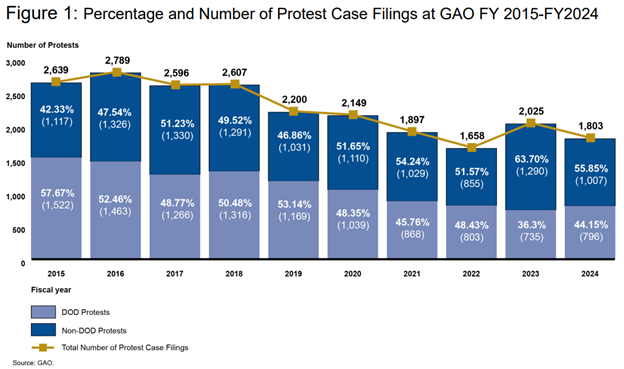
On December 12, 2025, the Government Accountability Office (GAO) released its Bid Protest Annual Report to Congress for Fiscal Year 2025. This report, required by the Competition in Contracting Act of 1984, provides Congress GAO’s bid protest statistics covering fiscal year 2025, including the most prevalent reasons GAO sustained protests. The 2025 GAO report reveals that bid protest filings were down 6% as compared to last year (1,688 in FY 2025 as opposed to 1,803 in FY 2024). Aside from an increase in FY 2023—attributed to a large procurement resulting in numerous protests—bid protest activity at GAO has been steadily decreasing for several years as shown in the top row of the below table:

In fact, in a separate GAO report from this summer, GAO highlighted the downward trend in filings over the past decade. Since the recent highwater mark in 2016, filings have decreased 39% overall:

This past fiscal year, GAO resolved the merits of 380 of the 1,688 cases filed, reflecting the lowest number of cases in recent history. The remaining cases were dismissed or the protestor withdrew the protest. In sum, GAO sustained 53 protests, reflecting an approximate 14% sustain rate. The “Effectiveness Rate”—the percentage of cases where the protestor obtained some form of relief either through the procuring agency taking voluntary corrective action or the GAO sustaining the protest—remained the same as FY 2024, at 52%. Thus, last year, protesters obtained some relief in more than half of the cases filed. Indeed, GAO’s Effectiveness Rate has remained relatively steady even as the number of protest filings continues to drop. GAO further reported that it conducted a hearing in three cases (continuing the relatively rare usage of this procedure), and notably, alternative dispute resolution (ADR) was markedly down 31% last year (53 ADR cases in 2025 versus 76 ADR cases in 2024). However, when GAO undertook ADR, that process proved successful in 91% of the cases, which remains consistent with the last four fiscal years.
Finally, GAO reported that the three most prevalent grounds resulting in GAO sustaining a bid protest were: (1) unreasonable technical evaluation; (2) unreasonable cost or price evaluation; and (3) unreasonable rejection of an offeror’s proposal. This year, unreasonable rejection of a proposal supplanted “flawed selection decision,” but the other two grounds remained in the top three reasons supporting GAO’s sustain decisions.
Jenner & Block’s Government Contracts lawyers have extensive bid protest experience, including prior service as a supervising bid protest hearing officer at GAO, and stand ready to support any challenges to the award of a government contract or the terms of a solicitation.
This article is available in the Jenner & Block Japan Newsletter. / この記事はJenner & Blockニュースレターに掲載されています。
In fact, in a separate GAO report from this summer, GAO highlighted the downward trend in filings over the past decade. Since the recent highwater mark in 2016, filings have decreased 39% overall:

This past fiscal year, GAO resolved the merits of 380 of the 1,688 cases filed, reflecting the lowest number of cases in recent history. The remaining cases were dismissed or the protestor withdrew the protest. In sum, GAO sustained 53 protests, reflecting an approximate 14% sustain rate. The “Effectiveness Rate”—the percentage of cases where the protestor obtained some form of relief either through the procuring agency taking voluntary corrective action or the GAO sustaining the protest—remained the same as FY 2024, at 52%. Thus, last year, protesters obtained some relief in more than half of the cases filed. Indeed, GAO’s Effectiveness Rate has remained relatively steady even as the number of protest filings continues to drop. GAO further reported that it conducted a hearing in three cases (continuing the relatively rare usage of this procedure), and notably, alternative dispute resolution (ADR) was markedly down 31% last year (53 ADR cases in 2025 versus 76 ADR cases in 2024). However, when GAO undertook ADR, that process proved successful in 91% of the cases, which remains consistent with the last four fiscal years.
Finally, GAO reported that the three most prevalent grounds resulting in GAO sustaining a bid protest were: (1) unreasonable technical evaluation; (2) unreasonable cost or price evaluation; and (3) unreasonable rejection of an offeror’s proposal. This year, unreasonable rejection of a proposal supplanted “flawed selection decision,” but the other two grounds remained in the top three reasons supporting GAO’s sustain decisions.
Jenner & Block’s Government Contracts lawyers have extensive bid protest experience, including prior service as a supervising bid protest hearing officer at GAO, and stand ready to support any challenges to the award of a government contract or the terms of a solicitation.
This article is available in the Jenner & Block Japan Newsletter. / この記事はJenner & Blockニュースレターに掲載されています。
Related Articles
Related Capabilities
© 2026 Jenner & Block LLP. Attorney Advertising. Jenner & Block LLP is an Illinois Limited Liability Partnership including professional corporations. This publication, presentation, or event is not intended to provide legal advice but to provide information on legal matters and/or firm news of interest to our clients and colleagues. Readers or attendees should seek specific legal advice before taking any action with respect to matters mentioned in this publication or at this event. The attorney responsible for this communication is Brent E. Kidwell, Jenner & Block LLP, 353 N. Clark Street, Chicago, IL 60654-3456. Prior results do not guarantee a similar outcome. Jenner & Block London LLP, an affiliate of Jenner & Block LLP, is a limited liability partnership established under the laws of the State of Delaware, USA and is authorised and regulated by the Solicitors Regulation Authority with SRA number 615729. Information regarding the data we collect and the rights you have over your data can be found in our Privacy Notice. For further inquiries, please contact dataprotection@jenner.com.
Client Alerts
December 23, 2025
By: Noah B. Bleicher, Moshe B. Broder, Elizabeth Pullin, Aime J. Joo, Jennifer Eve Retener
On December 12, 2025, the Government Accountability Office (GAO) released its Bid Protest Annual Report to Congress for Fiscal Year 2025. This report, required by the Competition in Contracting Act of 1984, provides Congress GAO’s bid protest statistics covering fiscal year 2025, including the most prevalent reasons GAO sustained protests. The 2025 GAO report reveals that bid protest filings were down 6% as compared to last year (1,688 in FY 2025 as opposed to 1,803 in FY 2024). Aside from an increase in FY 2023—attributed to a large procurement resulting in numerous protests—bid protest activity at GAO has been steadily decreasing for several years as shown in the top row of the below table:

In fact, in a separate GAO report from this summer, GAO highlighted the downward trend in filings over the past decade. Since the recent highwater mark in 2016, filings have decreased 39% overall:

This past fiscal year, GAO resolved the merits of 380 of the 1,688 cases filed, reflecting the lowest number of cases in recent history. The remaining cases were dismissed or the protestor withdrew the protest. In sum, GAO sustained 53 protests, reflecting an approximate 14% sustain rate. The “Effectiveness Rate”—the percentage of cases where the protestor obtained some form of relief either through the procuring agency taking voluntary corrective action or the GAO sustaining the protest—remained the same as FY 2024, at 52%. Thus, last year, protesters obtained some relief in more than half of the cases filed. Indeed, GAO’s Effectiveness Rate has remained relatively steady even as the number of protest filings continues to drop. GAO further reported that it conducted a hearing in three cases (continuing the relatively rare usage of this procedure), and notably, alternative dispute resolution (ADR) was markedly down 31% last year (53 ADR cases in 2025 versus 76 ADR cases in 2024). However, when GAO undertook ADR, that process proved successful in 91% of the cases, which remains consistent with the last four fiscal years.
Finally, GAO reported that the three most prevalent grounds resulting in GAO sustaining a bid protest were: (1) unreasonable technical evaluation; (2) unreasonable cost or price evaluation; and (3) unreasonable rejection of an offeror’s proposal. This year, unreasonable rejection of a proposal supplanted “flawed selection decision,” but the other two grounds remained in the top three reasons supporting GAO’s sustain decisions.
Jenner & Block’s Government Contracts lawyers have extensive bid protest experience, including prior service as a supervising bid protest hearing officer at GAO, and stand ready to support any challenges to the award of a government contract or the terms of a solicitation.
This article is available in the Jenner & Block Japan Newsletter. / この記事はJenner & Blockニュースレターに掲載されています。
In fact, in a separate GAO report from this summer, GAO highlighted the downward trend in filings over the past decade. Since the recent highwater mark in 2016, filings have decreased 39% overall:

This past fiscal year, GAO resolved the merits of 380 of the 1,688 cases filed, reflecting the lowest number of cases in recent history. The remaining cases were dismissed or the protestor withdrew the protest. In sum, GAO sustained 53 protests, reflecting an approximate 14% sustain rate. The “Effectiveness Rate”—the percentage of cases where the protestor obtained some form of relief either through the procuring agency taking voluntary corrective action or the GAO sustaining the protest—remained the same as FY 2024, at 52%. Thus, last year, protesters obtained some relief in more than half of the cases filed. Indeed, GAO’s Effectiveness Rate has remained relatively steady even as the number of protest filings continues to drop. GAO further reported that it conducted a hearing in three cases (continuing the relatively rare usage of this procedure), and notably, alternative dispute resolution (ADR) was markedly down 31% last year (53 ADR cases in 2025 versus 76 ADR cases in 2024). However, when GAO undertook ADR, that process proved successful in 91% of the cases, which remains consistent with the last four fiscal years.
Finally, GAO reported that the three most prevalent grounds resulting in GAO sustaining a bid protest were: (1) unreasonable technical evaluation; (2) unreasonable cost or price evaluation; and (3) unreasonable rejection of an offeror’s proposal. This year, unreasonable rejection of a proposal supplanted “flawed selection decision,” but the other two grounds remained in the top three reasons supporting GAO’s sustain decisions.
Jenner & Block’s Government Contracts lawyers have extensive bid protest experience, including prior service as a supervising bid protest hearing officer at GAO, and stand ready to support any challenges to the award of a government contract or the terms of a solicitation.
This article is available in the Jenner & Block Japan Newsletter. / この記事はJenner & Blockニュースレターに掲載されています。
Related Articles
Related Capabilities
© 2026 Jenner & Block LLP. Attorney Advertising. Jenner & Block LLP is an Illinois Limited Liability Partnership including professional corporations. This publication, presentation, or event is not intended to provide legal advice but to provide information on legal matters and/or firm news of interest to our clients and colleagues. Readers or attendees should seek specific legal advice before taking any action with respect to matters mentioned in this publication or at this event. The attorney responsible for this communication is Brent E. Kidwell, Jenner & Block LLP, 353 N. Clark Street, Chicago, IL 60654-3456. Prior results do not guarantee a similar outcome. Jenner & Block London LLP, an affiliate of Jenner & Block LLP, is a limited liability partnership established under the laws of the State of Delaware, USA and is authorised and regulated by the Solicitors Regulation Authority with SRA number 615729. Information regarding the data we collect and the rights you have over your data can be found in our Privacy Notice. For further inquiries, please contact dataprotection@jenner.com.
News and Insights
Event
Associate Steven Arango to Speak at the Veterans' Legal Career Fair
On September 18, Associate Steven Arango will speak on a panel at the Veterans' Legal Career Fair (VLCF), the only legal career fair in the United States dedicated to veterans, active-duty service members, and military spouses.
September 18, 2026
Publications
In American Banker, Partner Laurel Loomis Rimon Weighs in on OCC's Handling of Fintech Bank Charter Applications
Partner Laurel Loomis Rimon spoke with American Banker about how the Office of the Comptroller of the Currency is approaching bank charter applications from fintechs, amid a growing wave of companies seeking charters from federal regulators.
August 18, 2026
Event
Partner David Greenwald to Speak at PLI Program on Privilege and AI
On August 17, David Greenwald will speak at "Fitting New “Tech” Into the Attorney-Client Privilege and Work Product Protection," a virtual program hosted by the Practising Law Institute (PLI).
August 17, 2026
Publications
Special Counsel Kimberly Cook Featured in FCBA Member Spotlight
The Federal Communications Bar Association (FCBA) featured Kimberly Cook in its Member Spotlight series.
August 13, 2026
Recognition
Three Jenner & Block Partners Named to Crain's New York Business' 2026 Notable Leaders in Accounting, Consulting & Law List
Crain's New York Business recognized Jenner & Block Partners Anthony Barkow, Alison Stein, and Damian Williams among its 2026 Notable Leaders in Accounting, Consulting & Law.
August 10, 2026