


The 2026 State Attorneys General Elections and What Comes Next
Client Alerts
November 4, 2026
By: Venus D. Johnson, Katie B. Johnson, Caroline Cease, Brian Hauck, Miroslava Becerra Garcia, Jessica Bolin
Introduction
As state attorneys general (AGs) continue to fill the enforcement void left by federal regulators, this midterm cycle showed candidates in both parties focused on consumer-facing enforcement, with affordability, cost-of-living pressures, and Artificial Intelligence (AI) safety guardrails featured prominently across races. Of the 31 AG seats on Tuesday’s ballots (including the District of Columbia), 20 had an incumbent seeking re-election, and 11 were open seats. Although results are not yet final, it is apparent there will be meaningful changes.
| Seats at Issue | Wins | |
|---|---|---|
| Incumbents vs. Challengers | 20 | 18 incumbents, 2 challengers |
| Open Seats | 11 | 7 Democrats, 4 Republicans |
| Overall | 31 | 22 Democrats, 9 Republicans |
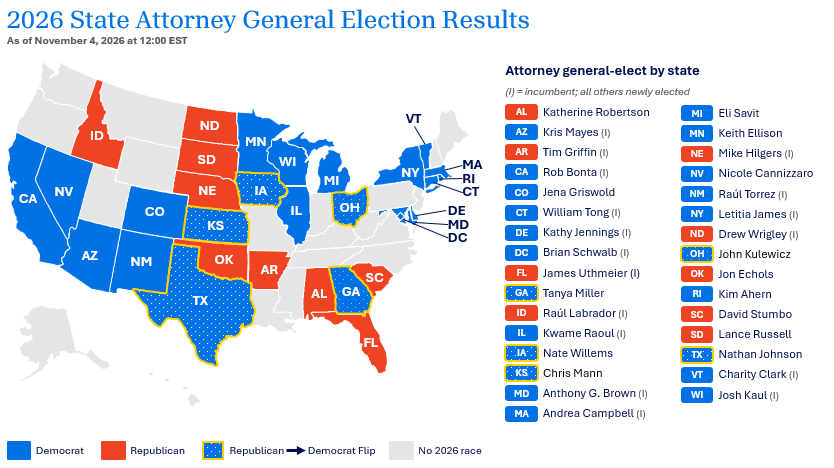
Heading into 2027, and considering states where there was no 2026 AG election, Democrats will hold 29 AG offices nationally (five seats gained), and Republicans will hold 22 offices (five seats lost).
Beyond the topline numbers, the bigger story is who is arriving. In January, thirteen states will have a new attorney general. Of those, five changed parties—in Georgia, Iowa, Kansas, Ohio, and Texas—and eight stayed with the same party. New AGs can reset an office’s enforcement and staffing priorities, and its alliances, even if the seat stays in the same party’s hands.
These transitions will continue to shape which investigations continue, which multistate coalitions gain or lose members, and where new enforcement activity is most likely to emerge. The most influential offices have the power to shape national policy debates. Companies should treat these transitions as a prompt to revisit their state regulatory strategy, especially in consumer protection, privacy, antitrust, and AI, and begin mapping how Tuesday's results will affect their business.
What This Means
While governing is different from campaigning and past actions do not dictate future priorities, candidates’ campaign platforms and incumbents’ enforcement records point to an agenda built on existing consumer protection, antitrust, and privacy laws, and a majority cuts across party lines. Below are four key areas we expect to take center stage, many of them with bipartisan backing, with AGs leveraging existing laws rather than waiting on new statutes to be enacted.
Affordability. Affordability is an organizing theme of bipartisan AG enforcement, providing a unifying rationale for scrutinizing nearly any industry that touches household costs. AGs are applying their consumer protection, antitrust, and ratepayer-advocacy powers to target costs voters feel most, including healthcare, utilities, and housing. Republican AGs have largely tied cost-of-living pledges to antitrust actions against concentrated industries, often alongside the Trump Department of Justice (DOJ). Democratic AGs are pursuing similar corporate cases, while also challenging federal policies, notably tariffs, that they argue raise prices for consumers. This theme has also been formalized by National Association of Attorneys General President William Tong in his 2026 Presidential Initiative to drive down costs for American families. Key affordability areas include:
-
- Public utilities and data centers. Rising electricity costs have emerged as a leading affordability concern, driven in part by growing power demands from data centers. AGs have been active in the rate-setting proceedings, with recent efforts opposing utilities’ proposed rate increases, asking regulators to create separate rate classes for data center customers, urging regulators to hold off approving data center power deals until ratepayer risks are addressed, and pressing for public votes on data center contracts. The tension around data centers is being felt nationwide and will continue to be politically potent, especially as we see efforts such as New York’s first data center moratorium attempting to reconcile grid capacity and environmental rules with hyperscale proposals.
- Pricing. AGs are scrutinizing how companies use personal data to set individualized prices, including using existing anti-discrimination and privacy laws. A bipartisan coalition recently urged the Federal Trade Commission (FTC) to issue a federal rule defining what conduct violates existing law, with states such as California announcing major investigative sweeps.
- Fees. Enforcement against so-called hidden or mandatory fees continues across housing, food delivery, and other consumer sectors. On top of various state investigations, a bipartisan coalition of 16 AG offices recently urged the FTC to extend its fee rule to online food delivery platforms.
Artificial Intelligence. In the absence of comprehensive federal AI regulation, bipartisan AG actions are likely to continue. Recent incidents have intensified calls for both AI regulation and enforcement, and attorneys general have been at the forefront. Recent AG actions have focused on cybersecurity, child safety, and a range of other issues.
Surveillance. Data broker companies and industries involved in a range of monitoring or surveillance-like activities will continue to draw attention as AI tools make large-scale data collection and analysis easier. State enforcement accelerated in 2026, with state enforcement actions involving the sale of drivers’ location data, and Connecticut’s ban on selling precise location data. AGs are increasingly using both privacy statutes and consumer protection laws to challenge how companies handle sensitive data, including children’s information, biometrics, and location data. Companies that collect, store, or share location and identity data with public agencies should expect questions about retention, access controls, and downstream use.
Prediction markets. These markets are a live enforcement fight. AGs are treating sporting event contracts as unlicensed gambling, putting them in direct conflict with federal regulators over who has authority to oversee this activity. Dozens of AGs from both parties have filed suit or joined amicus briefs on these issues. The Commodity Futures Trading Commission and DOJ have pushed back by suing states to block enforcement, and courts are split on who has regulatory authority. Sectors that blend financial, gaming, and consumer-facing features should expect scrutiny from more than one regulator at once.
The Implications
Controlling the narrative matters. Even before any litigation is filed, attorneys general can shape the narrative behind their legal theory by framing an industry’s conduct through press conferences, social media, and the power of the bully pulpit. The AG’s narrative, combined with the company’s reaction, can reach new audiences and invite further scrutiny, including from the press, legislators, Congress, and other enforcement actors. Companies should carefully review past and future statements about consumer safety, pricing, and privacy protections against how their products and practices actually work to ensure the two are in lockstep. Legal, product, and communications teams should be aligned before any state AG action begins in order to better avoid scrutiny and control the narrative.
As states continue to build their regulatory capacity, we anticipate enforcement in these areas will only grow stronger and more versatile, regardless of which party holds federal office or controls Congress. Although there are strong divisions on many social and policy issues, state AGs are still willing to work across party lines in many contexts—as seen in the bipartisan coalitions involved in AI, food delivery fees, and prediction market actions. AG lawsuits and investigations can run in parallel, and are often coordinated, with congressional and federal activity, and what a company tells one audience can reach or pique the interest of others.
The transition itself creates both risk and opportunity. New AGs will take office without enforcement records of their own, and their first appointments, public statements, and decisions about which coalitions to join or lead will signal which investigations will continue and which new ones will begin. In open-seat states, senior staff may depart with the outgoing AG, which could leave pending matters in flux. Companies with open inquiries should consider whether the transition window is the right moment to seek resolution or to reset the conversation with new leadership. They should also keep in mind the interplay between federal and state investigations. Congressional committees may signal coordination with state attorneys general on parallel investigations, and documents produced to Congress will not necessarily stay on Capitol Hill. A response strategy built for one forum should be carefully assessed for its potential impact on other players.
Conclusion
Clients should minimize and manage exposure by engaging with counsel to better position themselves to protect sensitive information and shape their record and narrative before scrutiny becomes public.
Jenner & Block’s State Attorneys General Practice remains ready to help clients assess their exposure, advise on the legal and enforcement consequences of business and policy decisions, structure privileged reviews, and respond to AG investigations, inquiries, and lawsuits as they arise.
| Seats at Issue | Wins | |
|---|---|---|
| Incumbents vs. Challengers | 20 | 18 incumbents, 2 challengers |
| Open Seats | 11 | 7 Democrats, 4 Republicans |
| Overall | 31 | 22 Democrats, 9 Republicans |
Heading into 2027, and considering states where there was no 2026 AG election, Democrats will hold 29 AG offices nationally (five seats gained), and Republicans will hold 22 offices (five seats lost).
Beyond the topline numbers, the bigger story is who is arriving. In January, thirteen states will have a new attorney general. Of those, five changed parties—in Georgia, Iowa, Kansas, Ohio, and Texas—and eight stayed with the same party. New AGs can reset an office’s enforcement and staffing priorities, and its alliances, even if the seat stays in the same party’s hands.
These transitions will continue to shape which investigations continue, which multistate coalitions gain or lose members, and where new enforcement activity is most likely to emerge. The most influential offices have the power to shape national policy debates. Companies should treat these transitions as a prompt to revisit their state regulatory strategy, especially in consumer protection, privacy, antitrust, and AI, and begin mapping how Tuesday's results will affect their business.
What This Means
While governing is different from campaigning and past actions do not dictate future priorities, candidates’ campaign platforms and incumbents’ enforcement records point to an agenda built on existing consumer protection, antitrust, and privacy laws, and a majority cuts across party lines. Below are four key areas we expect to take center stage, many of them with bipartisan backing, with AGs leveraging existing laws rather than waiting on new statutes to be enacted.
Affordability. Affordability is an organizing theme of bipartisan AG enforcement, providing a unifying rationale for scrutinizing nearly any industry that touches household costs. AGs are applying their consumer protection, antitrust, and ratepayer-advocacy powers to target costs voters feel most, including healthcare, utilities, and housing. Republican AGs have largely tied cost-of-living pledges to antitrust actions against concentrated industries, often alongside the Trump Department of Justice (DOJ). Democratic AGs are pursuing similar corporate cases, while also challenging federal policies, notably tariffs, that they argue raise prices for consumers. This theme has also been formalized by National Association of Attorneys General President William Tong in his 2026 Presidential Initiative to drive down costs for American families. Key affordability areas include:
-
- Public utilities and data centers. Rising electricity costs have emerged as a leading affordability concern, driven in part by growing power demands from data centers. AGs have been active in the rate-setting proceedings, with recent efforts opposing utilities’ proposed rate increases, asking regulators to create separate rate classes for data center customers, urging regulators to hold off approving data center power deals until ratepayer risks are addressed, and pressing for public votes on data center contracts. The tension around data centers is being felt nationwide and will continue to be politically potent, especially as we see efforts such as New York’s first data center moratorium attempting to reconcile grid capacity and environmental rules with hyperscale proposals.
- Pricing. AGs are scrutinizing how companies use personal data to set individualized prices, including using existing anti-discrimination and privacy laws. A bipartisan coalition recently urged the Federal Trade Commission (FTC) to issue a federal rule defining what conduct violates existing law, with states such as California announcing major investigative sweeps.
- Fees. Enforcement against so-called hidden or mandatory fees continues across housing, food delivery, and other consumer sectors. On top of various state investigations, a bipartisan coalition of 16 AG offices recently urged the FTC to extend its fee rule to online food delivery platforms.
Artificial Intelligence. In the absence of comprehensive federal AI regulation, bipartisan AG actions are likely to continue. Recent incidents have intensified calls for both AI regulation and enforcement, and attorneys general have been at the forefront. Recent AG actions have focused on cybersecurity, child safety, and a range of other issues.
Surveillance. Data broker companies and industries involved in a range of monitoring or surveillance-like activities will continue to draw attention as AI tools make large-scale data collection and analysis easier. State enforcement accelerated in 2026, with state enforcement actions involving the sale of drivers’ location data, and Connecticut’s ban on selling precise location data. AGs are increasingly using both privacy statutes and consumer protection laws to challenge how companies handle sensitive data, including children’s information, biometrics, and location data. Companies that collect, store, or share location and identity data with public agencies should expect questions about retention, access controls, and downstream use.
Prediction markets. These markets are a live enforcement fight. AGs are treating sporting event contracts as unlicensed gambling, putting them in direct conflict with federal regulators over who has authority to oversee this activity. Dozens of AGs from both parties have filed suit or joined amicus briefs on these issues. The Commodity Futures Trading Commission and DOJ have pushed back by suing states to block enforcement, and courts are split on who has regulatory authority. Sectors that blend financial, gaming, and consumer-facing features should expect scrutiny from more than one regulator at once.
The Implications
Controlling the narrative matters. Even before any litigation is filed, attorneys general can shape the narrative behind their legal theory by framing an industry’s conduct through press conferences, social media, and the power of the bully pulpit. The AG’s narrative, combined with the company’s reaction, can reach new audiences and invite further scrutiny, including from the press, legislators, Congress, and other enforcement actors. Companies should carefully review past and future statements about consumer safety, pricing, and privacy protections against how their products and practices actually work to ensure the two are in lockstep. Legal, product, and communications teams should be aligned before any state AG action begins in order to better avoid scrutiny and control the narrative.
As states continue to build their regulatory capacity, we anticipate enforcement in these areas will only grow stronger and more versatile, regardless of which party holds federal office or controls Congress. Although there are strong divisions on many social and policy issues, state AGs are still willing to work across party lines in many contexts—as seen in the bipartisan coalitions involved in AI, food delivery fees, and prediction market actions. AG lawsuits and investigations can run in parallel, and are often coordinated, with congressional and federal activity, and what a company tells one audience can reach or pique the interest of others.
The transition itself creates both risk and opportunity. New AGs will take office without enforcement records of their own, and their first appointments, public statements, and decisions about which coalitions to join or lead will signal which investigations will continue and which new ones will begin. In open-seat states, senior staff may depart with the outgoing AG, which could leave pending matters in flux. Companies with open inquiries should consider whether the transition window is the right moment to seek resolution or to reset the conversation with new leadership. They should also keep in mind the interplay between federal and state investigations. Congressional committees may signal coordination with state attorneys general on parallel investigations, and documents produced to Congress will not necessarily stay on Capitol Hill. A response strategy built for one forum should be carefully assessed for its potential impact on other players.
Conclusion
Clients should minimize and manage exposure by engaging with counsel to better position themselves to protect sensitive information and shape their record and narrative before scrutiny becomes public.
Jenner & Block’s State Attorneys General Practice remains ready to help clients assess their exposure, advise on the legal and enforcement consequences of business and policy decisions, structure privileged reviews, and respond to AG investigations, inquiries, and lawsuits as they arise.
Related Lawyers




Related Capabilities
© 2026 Jenner & Block LLP. Attorney Advertising. Jenner & Block LLP is an Illinois Limited Liability Partnership including professional corporations. This publication, presentation, or event is not intended to provide legal advice but to provide information on legal matters and/or firm news of interest to our clients and colleagues. Readers or attendees should seek specific legal advice before taking any action with respect to matters mentioned in this publication or at this event. The attorney responsible for this communication is Brent E. Kidwell, Jenner & Block LLP, 353 N. Clark Street, Chicago, IL 60654-3456. Prior results do not guarantee a similar outcome. Jenner & Block London LLP, an affiliate of Jenner & Block LLP, is a limited liability partnership established under the laws of the State of Delaware, USA and is authorised and regulated by the Solicitors Regulation Authority with SRA number 615729. Information regarding the data we collect and the rights you have over your data can be found in our Privacy Notice. For further inquiries, please contact dataprotection@jenner.com.
Client Alerts
November 4, 2026
By: Venus D. Johnson, Katie B. Johnson, Caroline Cease, Brian Hauck, Miroslava Becerra Garcia, Jessica Bolin
Introduction
As state attorneys general (AGs) continue to fill the enforcement void left by federal regulators, this midterm cycle showed candidates in both parties focused on consumer-facing enforcement, with affordability, cost-of-living pressures, and Artificial Intelligence (AI) safety guardrails featured prominently across races. Of the 31 AG seats on Tuesday’s ballots (including the District of Columbia), 20 had an incumbent seeking re-election, and 11 were open seats. Although results are not yet final, it is apparent there will be meaningful changes.
| Seats at Issue | Wins | |
|---|---|---|
| Incumbents vs. Challengers | 20 | 18 incumbents, 2 challengers |
| Open Seats | 11 | 7 Democrats, 4 Republicans |
| Overall | 31 | 22 Democrats, 9 Republicans |
Heading into 2027, and considering states where there was no 2026 AG election, Democrats will hold 29 AG offices nationally (five seats gained), and Republicans will hold 22 offices (five seats lost).
Beyond the topline numbers, the bigger story is who is arriving. In January, thirteen states will have a new attorney general. Of those, five changed parties—in Georgia, Iowa, Kansas, Ohio, and Texas—and eight stayed with the same party. New AGs can reset an office’s enforcement and staffing priorities, and its alliances, even if the seat stays in the same party’s hands.
These transitions will continue to shape which investigations continue, which multistate coalitions gain or lose members, and where new enforcement activity is most likely to emerge. The most influential offices have the power to shape national policy debates. Companies should treat these transitions as a prompt to revisit their state regulatory strategy, especially in consumer protection, privacy, antitrust, and AI, and begin mapping how Tuesday's results will affect their business.
What This Means
While governing is different from campaigning and past actions do not dictate future priorities, candidates’ campaign platforms and incumbents’ enforcement records point to an agenda built on existing consumer protection, antitrust, and privacy laws, and a majority cuts across party lines. Below are four key areas we expect to take center stage, many of them with bipartisan backing, with AGs leveraging existing laws rather than waiting on new statutes to be enacted.
Affordability. Affordability is an organizing theme of bipartisan AG enforcement, providing a unifying rationale for scrutinizing nearly any industry that touches household costs. AGs are applying their consumer protection, antitrust, and ratepayer-advocacy powers to target costs voters feel most, including healthcare, utilities, and housing. Republican AGs have largely tied cost-of-living pledges to antitrust actions against concentrated industries, often alongside the Trump Department of Justice (DOJ). Democratic AGs are pursuing similar corporate cases, while also challenging federal policies, notably tariffs, that they argue raise prices for consumers. This theme has also been formalized by National Association of Attorneys General President William Tong in his 2026 Presidential Initiative to drive down costs for American families. Key affordability areas include:
-
- Public utilities and data centers. Rising electricity costs have emerged as a leading affordability concern, driven in part by growing power demands from data centers. AGs have been active in the rate-setting proceedings, with recent efforts opposing utilities’ proposed rate increases, asking regulators to create separate rate classes for data center customers, urging regulators to hold off approving data center power deals until ratepayer risks are addressed, and pressing for public votes on data center contracts. The tension around data centers is being felt nationwide and will continue to be politically potent, especially as we see efforts such as New York’s first data center moratorium attempting to reconcile grid capacity and environmental rules with hyperscale proposals.
- Pricing. AGs are scrutinizing how companies use personal data to set individualized prices, including using existing anti-discrimination and privacy laws. A bipartisan coalition recently urged the Federal Trade Commission (FTC) to issue a federal rule defining what conduct violates existing law, with states such as California announcing major investigative sweeps.
- Fees. Enforcement against so-called hidden or mandatory fees continues across housing, food delivery, and other consumer sectors. On top of various state investigations, a bipartisan coalition of 16 AG offices recently urged the FTC to extend its fee rule to online food delivery platforms.
Artificial Intelligence. In the absence of comprehensive federal AI regulation, bipartisan AG actions are likely to continue. Recent incidents have intensified calls for both AI regulation and enforcement, and attorneys general have been at the forefront. Recent AG actions have focused on cybersecurity, child safety, and a range of other issues.
Surveillance. Data broker companies and industries involved in a range of monitoring or surveillance-like activities will continue to draw attention as AI tools make large-scale data collection and analysis easier. State enforcement accelerated in 2026, with state enforcement actions involving the sale of drivers’ location data, and Connecticut’s ban on selling precise location data. AGs are increasingly using both privacy statutes and consumer protection laws to challenge how companies handle sensitive data, including children’s information, biometrics, and location data. Companies that collect, store, or share location and identity data with public agencies should expect questions about retention, access controls, and downstream use.
Prediction markets. These markets are a live enforcement fight. AGs are treating sporting event contracts as unlicensed gambling, putting them in direct conflict with federal regulators over who has authority to oversee this activity. Dozens of AGs from both parties have filed suit or joined amicus briefs on these issues. The Commodity Futures Trading Commission and DOJ have pushed back by suing states to block enforcement, and courts are split on who has regulatory authority. Sectors that blend financial, gaming, and consumer-facing features should expect scrutiny from more than one regulator at once.
The Implications
Controlling the narrative matters. Even before any litigation is filed, attorneys general can shape the narrative behind their legal theory by framing an industry’s conduct through press conferences, social media, and the power of the bully pulpit. The AG’s narrative, combined with the company’s reaction, can reach new audiences and invite further scrutiny, including from the press, legislators, Congress, and other enforcement actors. Companies should carefully review past and future statements about consumer safety, pricing, and privacy protections against how their products and practices actually work to ensure the two are in lockstep. Legal, product, and communications teams should be aligned before any state AG action begins in order to better avoid scrutiny and control the narrative.
As states continue to build their regulatory capacity, we anticipate enforcement in these areas will only grow stronger and more versatile, regardless of which party holds federal office or controls Congress. Although there are strong divisions on many social and policy issues, state AGs are still willing to work across party lines in many contexts—as seen in the bipartisan coalitions involved in AI, food delivery fees, and prediction market actions. AG lawsuits and investigations can run in parallel, and are often coordinated, with congressional and federal activity, and what a company tells one audience can reach or pique the interest of others.
The transition itself creates both risk and opportunity. New AGs will take office without enforcement records of their own, and their first appointments, public statements, and decisions about which coalitions to join or lead will signal which investigations will continue and which new ones will begin. In open-seat states, senior staff may depart with the outgoing AG, which could leave pending matters in flux. Companies with open inquiries should consider whether the transition window is the right moment to seek resolution or to reset the conversation with new leadership. They should also keep in mind the interplay between federal and state investigations. Congressional committees may signal coordination with state attorneys general on parallel investigations, and documents produced to Congress will not necessarily stay on Capitol Hill. A response strategy built for one forum should be carefully assessed for its potential impact on other players.
Conclusion
Clients should minimize and manage exposure by engaging with counsel to better position themselves to protect sensitive information and shape their record and narrative before scrutiny becomes public.
Jenner & Block’s State Attorneys General Practice remains ready to help clients assess their exposure, advise on the legal and enforcement consequences of business and policy decisions, structure privileged reviews, and respond to AG investigations, inquiries, and lawsuits as they arise.
Related Lawyers
Related Capabilities
© 2026 Jenner & Block LLP. Attorney Advertising. Jenner & Block LLP is an Illinois Limited Liability Partnership including professional corporations. This publication, presentation, or event is not intended to provide legal advice but to provide information on legal matters and/or firm news of interest to our clients and colleagues. Readers or attendees should seek specific legal advice before taking any action with respect to matters mentioned in this publication or at this event. The attorney responsible for this communication is Brent E. Kidwell, Jenner & Block LLP, 353 N. Clark Street, Chicago, IL 60654-3456. Prior results do not guarantee a similar outcome. Jenner & Block London LLP, an affiliate of Jenner & Block LLP, is a limited liability partnership established under the laws of the State of Delaware, USA and is authorised and regulated by the Solicitors Regulation Authority with SRA number 615729. Information regarding the data we collect and the rights you have over your data can be found in our Privacy Notice. For further inquiries, please contact dataprotection@jenner.com.
News and Insights
Event
Partner Terri Mascherin to Speak at Illinois State Bar Association Seminar on Negotiation Ethics
On November 11, Partner Terri Mascherin will join a faculty panel for the Illinois State Bar Association (ISBA) continuing legal education (CLE) seminar “Negotiation Ethics: Winning Without Selling Your Soul.”
November 11, 2026
Publications
Partner Emily Loeb Discusses What the 2026 Midterms Mean for Congressional Oversight in the Financial Times
Partner Emily Loeb, co-chair of Jenner & Block’s Congressional Investigations Practice, was quoted in the Financial Times in an article examining how companies are preparing for congressional oversight as the new Congress takes shape following the 2026 midterm elections.
November 4, 2026
Recognition
Three Jenner & Block Partners Named 2026 Law360 MVPs
Law360 named Jenner & Block Partners Adam Unikowsky, Lindsay Harrison, and Rebekah Goodheart to its 2026 MVPs list.
November 3, 2026
Publications
Congressional Oversight after Trump v. United States, Lawfare
Special Counsel David Manners-Weber authored an article for Lawfare examining how the Supreme Court’s 2024 decision in Trump v. United States may weaken Congress’s ability to investigate the executive branch.
November 2, 2026
Publications
In Politico, Partner Emily Loeb Discusses How Companies Are Preparing for Congressional Oversight
Partner Emily Loeb was spoke with Politico for a story examining how companies are preparing for heightened congressional oversight, particularly those that could become the focus of investigations centered on affordability and accountability.
October 29, 2026
Recognition
Partner Katie Wynbrandt Named a 2026 Rising Star by The National Law Journal
Partner Katie Wynbrandt has been named a 2026 DC Rising Star in the appellate category by The National Law Journal at its DC Legal Awards.
October 26, 2026
Recognition
Jenner & Block Named Justice Impact Partner at MacArthur Justice Center’s 40th Anniversary Gala
Jenner & Block received the Justice Impact Partner Award at the MacArthur Justice Center’s 40th Anniversary Gala on October 14 in Chicago.
October 23, 2026